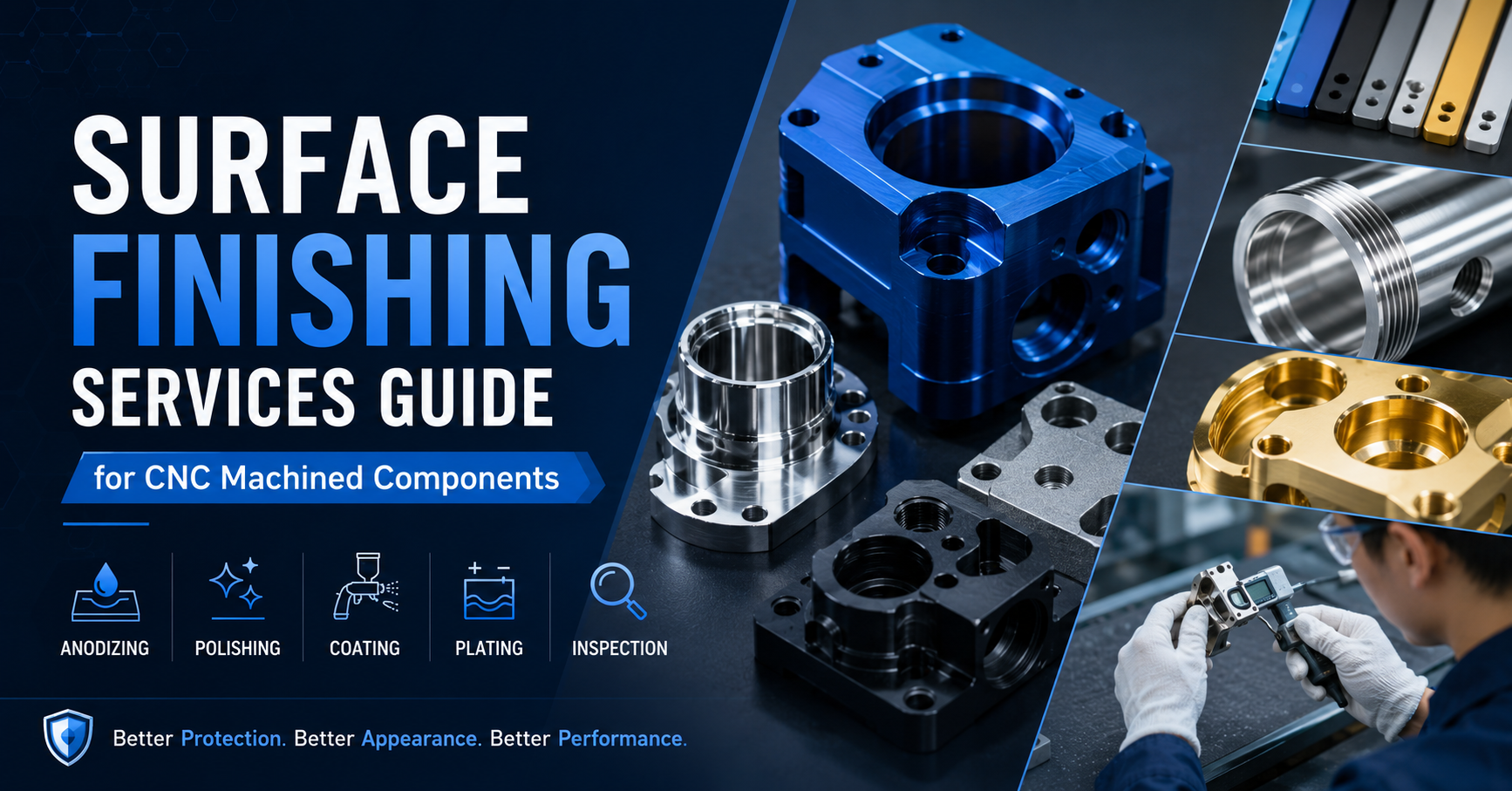

Why Surface Finishing Matters for CNC Machined Components
Manufacturing a metal component does not always end after machining. For many industrial applications, additional surface treatment is required to improve performance, appearance and long-term reliability.
Surface finishing services are an important part of the manufacturing process because they can influence:
- corrosion resistance
- wear resistance
- surface hardness
- appearance
- electrical performance
- product lifespan
For OEM manufacturers and industrial buyers, selecting the right finishing method is as important as selecting the machining process itself.
A properly selected finish can help CNC machined components perform better in demanding environments while reducing maintenance requirements and improving product value.
What Are Surface Finishing Services?
Surface finishing services are post-processing operations applied to manufactured parts to improve their functional or visual properties.
These processes are commonly used after:
- CNC machining
- casting
- sheet metal fabrication
- metal forming
Common surface finishing methods include:
- anodizing
- powder coating
- electroplating
- polishing
- bead blasting
- brushing
- passivation
- painting
Different finishes provide different advantages depending on:
- base material
- operating environment
- required appearance
- dimensional requirements
- performance expectations
Common Surface Finishing Options for CNC Parts
Choosing the correct finish requires understanding how each process affects the component.
Anodizing for Aluminum Components
Anodizing is one of the most common surface finishing services for aluminum parts.
The process creates a controlled oxide layer on the aluminum surface.
Benefits include:
- improved corrosion resistance
- increased surface hardness
- better appearance
- color customization
Anodizing is commonly used for:
- aluminum housings
- electronic enclosures
- aerospace components
- precision CNC parts
Common anodizing options include:
- clear anodizing
- black anodizing
- colored anodizing
- hard anodizing
Hard anodizing is often selected when higher wear resistance is required.
Powder Coating for Industrial Metal Parts
Powder coating is a durable finishing method widely used for steel and aluminum components.
The process applies dry powder to the surface and cures it under heat.
Advantages include:
- strong protection
- excellent appearance
- wide color selection
- resistance to scratches
Powder coating is commonly used for:
- equipment frames
- machine covers
- electrical cabinets
- industrial enclosures
It is suitable for applications requiring both protection and visual quality.
Electroplating and Protective Coatings
Electroplating applies a thin metal coating to improve surface performance.
Common plating materials include:
- nickel
- chrome
- zinc
Benefits include:
- corrosion protection
- improved wear resistance
- enhanced appearance
- improved conductivity
Plating is often used for:
- mechanical fasteners
- precision components
- industrial hardware
- electrical parts
The correct plating method depends on the working environment and functional requirements.
Bead Blasting and Surface Texture Improvement
Bead blasting uses abrasive media to create a consistent surface texture.
It is commonly used for:
- removing machining marks
- improving appearance
- preparing surfaces before coating
Benefits include:
- uniform matte finish
- improved cosmetic quality
- better coating adhesion
Bead blasting is often combined with anodizing for aluminum CNC machined components.
Polishing and Brushing
Polishing creates a smooth and reflective surface by reducing surface roughness.
Common applications include:
- decorative components
- stainless steel parts
- visible machine components
Brushing creates directional surface patterns that provide:
- premium appearance
- reduced fingerprint visibility
- consistent texture
These finishes are often selected when appearance is important.
How to Choose the Right Surface Finishing Process
Selecting the correct finish requires evaluating several factors.
Consider Material Compatibility
Different materials require different treatment methods.
Examples:
| Material | Common Finishes |
|---|---|
| Aluminum | Anodizing, blasting, polishing |
| Stainless Steel | Passivation, polishing, plating |
| Carbon Steel | Powder coating, plating, painting |
| Copper | Plating, polishing |
A finishing method suitable for aluminum may not provide the same result on steel or copper.
Consider Operating Environment
Environmental conditions affect finishing selection.
Important factors include:
- humidity
- chemicals
- temperature
- outdoor exposure
- mechanical wear
For example:
Outdoor components may require stronger corrosion protection.
Precision internal components may require controlled coating thickness.
Consider Dimensional Requirements
Surface treatment can change part dimensions.
For precision CNC machined components, buyers should consider:
- coating thickness
- masking requirements
- tolerance limits
Critical areas such as:
- threads
- bearing surfaces
- sealing areas
may require protection during finishing.
Surface Finishing Quality Control
Quality control is essential because finishing directly affects final product performance.
A professional supplier should inspect:
Surface Appearance
Checking:
- color consistency
- scratches
- coating defects
- texture uniformity
Coating Thickness
Important for:
- anodizing
- plating
- protective coatings
Adhesion Testing
Ensures coatings remain attached during operation.
Dimensional Verification
Confirms finishing does not affect critical measurements.
Surface Finishing Process Workflow
A typical finishing workflow includes:
| Stage | Description |
|---|---|
| Cleaning | Remove oil and contaminants |
| Surface Preparation | Blasting, polishing or treatment preparation |
| Finishing Application | Apply selected coating or treatment |
| Inspection | Verify appearance and performance |
| Packaging | Protect finished components |
Proper handling after finishing is also important to prevent scratches or contamination.
Benefits of Using Integrated Value Added Solutions
Many OEM buyers prefer suppliers that provide complete manufacturing support.
Combining machining and finishing services offers several advantages:
Reduced Supplier Management
Instead of coordinating multiple vendors, buyers can manage one manufacturing partner.
Better Process Control
The supplier understands:
- machining conditions
- finishing requirements
- tolerance limitations
Faster Production Flow
Parts do not need repeated transportation between different suppliers.
Improved Quality Responsibility
A single supplier can manage:
- machining
- finishing
- inspection
- packaging
Surface Finishing Selection Checklist
| Requirement | Recommended Consideration |
|---|---|
| Corrosion resistance | Coating or protective treatment |
| Appearance | Polishing, brushing, anodizing |
| Wear resistance | Hard coatings or plating |
| Electrical performance | Conductive finishing options |
| Precision tolerance | Masking and thickness control |
| Outdoor use | Weather-resistant finishing |
How to Choose a Surface Finishing Supplier
When evaluating suppliers, buyers should consider:
Finishing Capability
Check available processes:
- anodizing
- coating
- plating
- polishing
- blasting
Experience With CNC Parts
Finishing suppliers should understand:
- machining marks
- tolerance control
- critical surfaces
Quality Documentation
Important records may include:
- inspection reports
- coating thickness data
- process records
Communication Ability
Clear communication helps avoid:
- incorrect color selection
- coating problems
- dimensional issues
Frequently Asked Questions
Why are surface finishing services important?
Surface finishing improves corrosion resistance, appearance, durability and overall product performance.
What surface finish is best for aluminum CNC parts?
Anodizing is one of the most common choices because it improves corrosion resistance, hardness and appearance.
Can surface finishing affect part dimensions?
Yes. Coating thickness and treatment processes can influence dimensions, especially for precision components.
Which finishes are suitable for outdoor metal parts?
Powder coating, anodizing and protective plating are commonly used for outdoor applications.
Can one supplier provide machining and finishing services?
Yes. Many manufacturing suppliers provide integrated CNC machining, surface treatment, inspection and assembly solutions.
How should critical surfaces be handled before finishing?
Threads, sealing areas and precision mating surfaces may require masking or special processing instructions.
What information is needed for a finishing quotation?
Provide material type, surface requirement, color, finish standard, quantity and dimensional requirements.
How do I choose between anodizing and powder coating?
Anodizing is commonly used for aluminum precision parts, while powder coating is often selected for larger protective industrial components.