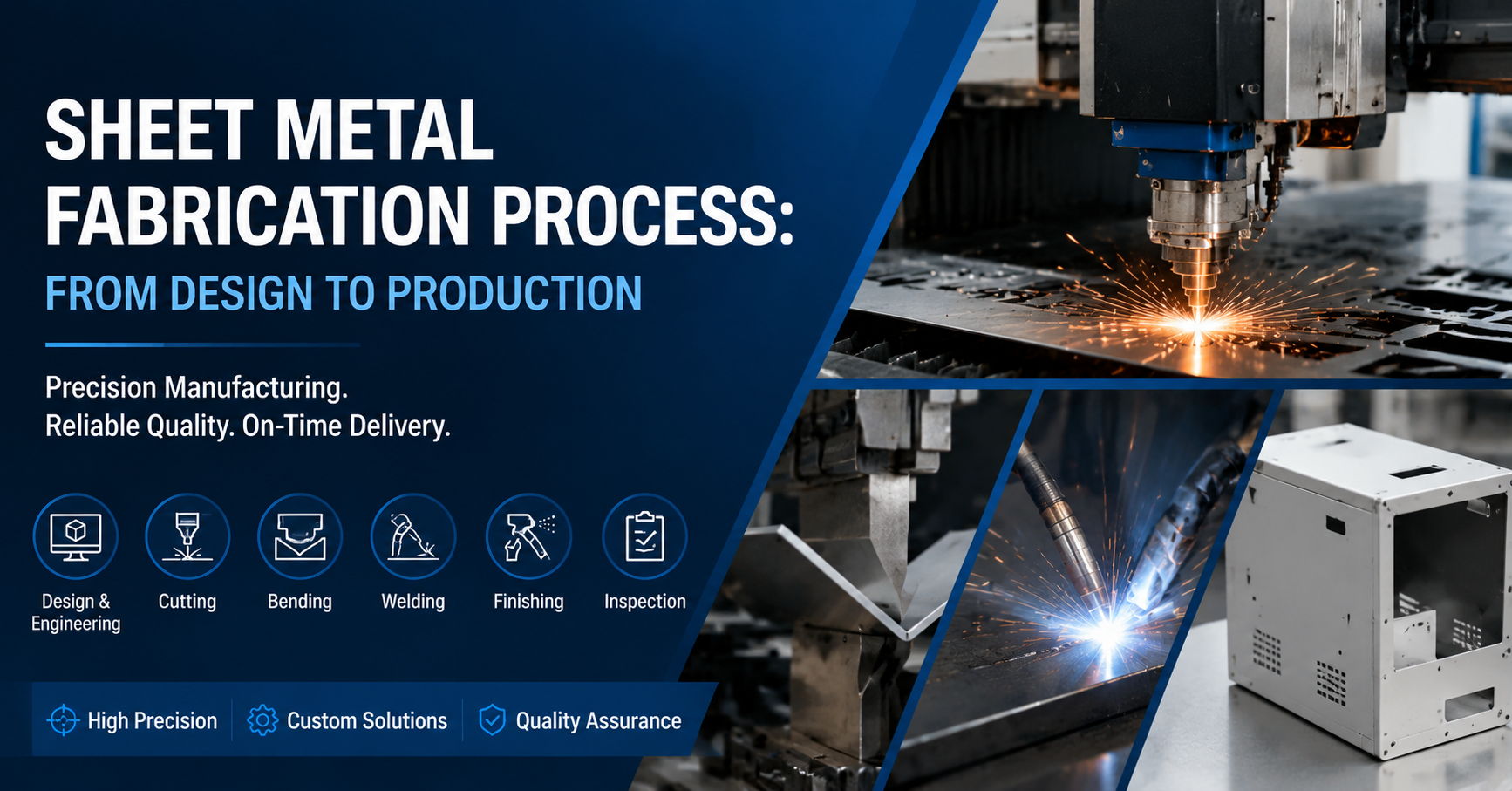

Why Understanding the Sheet Metal Fabrication Process Matters
Sheet metal fabrication is one of the most widely used manufacturing methods for producing industrial enclosures, machine covers, brackets, frames and structural components.
For OEM manufacturers, product developers and purchasing teams, understanding the complete sheet metal fabrication process helps improve supplier selection, reduce production risks and achieve better product performance.
A professional fabrication supplier does more than cut and bend metal sheets. They provide engineering support, material recommendations, manufacturing optimization, welding solutions, surface finishing and quality inspection.
The success of a sheet metal project depends on many factors, including:
- design quality
- material selection
- fabrication methods
- production accuracy
- finishing requirements
- supplier capability
Choosing an experienced sheet metal fabrication manufacturer can significantly improve production efficiency and product consistency.
What Is Sheet Metal Fabrication?
Sheet metal fabrication is a manufacturing process that transforms flat metal sheets into finished components through cutting, forming, joining and finishing operations.
Unlike machining, which removes material from solid blocks, sheet metal fabrication uses existing sheet materials and reshapes them into functional structures.
Common materials include:
| Material | Typical Applications |
|---|---|
| Stainless Steel | Food equipment, medical equipment, corrosion-resistant parts |
| Aluminum | Lightweight housings and industrial covers |
| Carbon Steel | Frames, brackets and structural components |
| Galvanized Steel | Outdoor and corrosion-resistant applications |
Typical sheet metal products include:
- electrical enclosures
- control cabinets
- machine covers
- equipment frames
- mounting brackets
- protective guards
- industrial panels
Complete Sheet Metal Fabrication Process
A successful fabrication project usually follows several important stages.
Design Review and Engineering Analysis
The fabrication process begins with reviewing customer drawings, CAD files and technical requirements.
During this stage, engineers evaluate:
- material thickness
- bend locations
- hole positions
- welding requirements
- assembly structure
- finishing requirements
Design review helps identify possible manufacturing issues before production.
Common problems that can be discovered early include:
- difficult bending operations
- unnecessary welding
- incorrect material selection
- unrealistic tolerances
A professional supplier may provide Design for Manufacturing (DFM) suggestions to improve cost efficiency and manufacturability.
Material Selection
Material selection directly affects:
- strength
- weight
- corrosion resistance
- appearance
- production cost
For example:
Stainless steel is suitable for environments requiring corrosion resistance.
Aluminum is often selected when lightweight construction is important.
Carbon steel provides excellent strength for structural applications.
The right material depends on:
- operating environment
- mechanical requirements
- temperature conditions
- surface treatment needs
Sheet Metal Cutting Process
Cutting is the first manufacturing operation that creates the required shape from flat metal sheets.
Common cutting methods include:
Laser Cutting
Laser cutting provides:
- high accuracy
- clean edges
- complex profiles
- fast production
It is widely used for:
- panels
- brackets
- enclosures
- precision sheet metal parts
CNC Punching
CNC punching is suitable for:
- repeated holes
- ventilation patterns
- standard shapes
- high-volume production
Waterjet Cutting
Waterjet cutting may be used for materials requiring:
- low heat influence
- thicker sections
- special material requirements
Sheet Metal Bending and Forming
After cutting, flat sheets are transformed into three-dimensional structures through bending.
Common forming operations include:
- press brake bending
- rolling
- folding
- forming
Bending accuracy depends on:
- material properties
- thickness
- bend radius
- tooling selection
- machine accuracy
Proper bending control is important because incorrect angles can affect final assembly.
Welding and Joining Operations
Many sheet metal assemblies require joining multiple components.
Common welding methods include:
TIG Welding
Suitable for:
- stainless steel
- aluminum
- appearance-critical components
MIG Welding
Suitable for:
- structural components
- larger assemblies
- production welding
Spot Welding
Commonly used for:
- panels
- brackets
- sheet assemblies
Besides welding, other joining methods include:
- riveting
- screws
- bolts
- self-clinching hardware
Surface Finishing for Sheet Metal Parts
Surface finishing improves:
- appearance
- corrosion resistance
- durability
- product value
Common finishing options include:
| Finish | Benefits |
|---|---|
| Powder Coating | Durable protective coating |
| Painting | Color customization |
| Brushing | Premium appearance |
| Polishing | Smooth surface finish |
| Plating | Corrosion protection |
The finishing choice depends on:
- environment
- customer requirements
- appearance expectations
- functional needs
Quality Control in Sheet Metal Fabrication
Quality control is essential for ensuring fabricated components meet customer expectations.
A professional metal fabrication services provider should inspect:
Dimensional Accuracy
Including:
- length
- width
- hole position
- bend angle
- assembly dimensions
Welding Quality
Inspection may include:
- weld appearance
- joint strength
- distortion control
Surface Quality
Checking:
- scratches
- coating consistency
- color requirements
- cosmetic defects
Final Assembly Inspection
For assembled products:
- component fit
- hardware installation
- functional operation
Prototype vs Mass Production Sheet Metal Fabrication
Different production stages require different manufacturing strategies.
| Factor | Prototype Production | Mass Production |
|---|---|---|
| Quantity | Small batches | Large volume |
| Design Changes | Frequent | Controlled |
| Tooling | Minimal | Optimized |
| Lead Time | Faster | Scheduled production |
| Cost Strategy | Development focused | Efficiency focused |
Prototype fabrication allows companies to verify:
- design structure
- installation method
- product appearance
- assembly performance
Mass production focuses on:
- consistency
- efficiency
- cost control
How to Choose a Sheet Metal Fabrication Manufacturer
Selecting the right supplier requires evaluating several factors.
Manufacturing Capability
Check whether the supplier supports:
- laser cutting
- bending
- welding
- finishing
- assembly
Engineering Support
A capable supplier should help with:
- material selection
- design improvement
- production optimization
Quality Management
Important evaluation points:
- inspection process
- production control
- documentation capability
Production Capacity
Consider:
- equipment availability
- workforce capability
- delivery reliability
Common Mistakes in Sheet Metal Projects
Ignoring Manufacturing Design Requirements
Poor designs may cause:
- increased cost
- production delays
- quality issues
Choosing Materials Without Considering Application
Incorrect material selection may lead to:
- corrosion problems
- insufficient strength
- unnecessary cost
Not Defining Surface Requirements
Unclear finishing requirements can create:
- appearance differences
- coating problems
- customer dissatisfaction
Sheet Metal Fabrication Checklist
| Item | Important Considerations |
|---|---|
| Material | Steel, stainless steel, aluminum selection |
| Thickness | Structural and forming requirements |
| Cutting | Laser, punching or special cutting |
| Bending | Radius and angle requirements |
| Welding | Joint design and appearance |
| Finishing | Coating and protection requirements |
| Inspection | Dimensional and visual checks |
Frequently Asked Questions
What is included in the sheet metal fabrication process?
The process usually includes design review, material preparation, cutting, bending, welding, finishing, inspection and assembly.
What materials can be used for sheet metal fabrication?
Common materials include stainless steel, aluminum, carbon steel and galvanized steel.
How long does sheet metal fabrication take?
Lead time depends on design complexity, quantity, material availability, finishing requirements and production scheduling.
Can sheet metal manufacturers produce prototypes?
Yes. Prototype fabrication is commonly used for product testing, design validation and engineering improvements.
What industries use sheet metal fabrication?
Industries include industrial equipment, electronics, automation, transportation, medical equipment and energy systems.
How can fabrication costs be reduced?
Costs can be reduced through optimized design, suitable materials, simplified assembly and early supplier involvement.
What is the difference between sheet metal fabrication and machining?
Sheet metal fabrication forms metal sheets through cutting and bending, while machining removes material from solid blocks.
Can fabricated parts include surface finishing?
Yes. Many suppliers provide powder coating, painting, polishing, brushing and other finishing options.